
In a split second, your fingers graze the searing metal of a stovetop. Before your brain even registers the heat or forms the thought of danger, your arm has already recoiled in a blur of motion. This is the withdrawal reflex, a biological masterpiece where sensory nerves in the skin bypass the brain entirely, sending a lightning-fast signal to the spinal cord to activate the muscles. Only after the movement has started does the brain receive the memo that something went wrong. For humans, this delay-free reaction is the difference between a minor sting and a life-altering burn.
稍不留意,你的手指触碰到滚烫的金属炉壁。还没等大脑反应过来,或意识到危险,你的手臂已经迅速缩回,这就是缩手反射,一种生物学杰作,皮肤中的感觉神经完全绕过大脑,向脊髓发送闪电般的信号以激活肌肉。对人类来说,这种无延迟的反应就是轻微蜇伤和改变人生的烧伤之间的区别。
Traditionally, if a robot encounters a hazard, its sensors must send raw data to a central processing unit (CPU), wait for the system to crunch the numbers, and then dispatch a command to the arm’s actuators. In the high-stakes world of mechanical hardware, even a micro-delay can lead to catastrophic damage. However, a team of scientists in China has now bridged this gap between biology and machinery, creating a neuromorphic robotic e-skin (NRE-skin) that allows machines to not only touch the world but to “feel” pain and react with the same instinctive urgency as a human being.
传统上,如果机器人遇到危险,传感器必须将原始数据发送给中央处理器(CPU),等待系统处理数据,然后向机械臂执行器发送指令。在机械硬件的高风险世界中,即使是微延迟也可能导致灾难性损坏。然而,中国的一组科学家现在已经架起了生物学与机械之间的桥梁,创造出一种神经形态机器人电子皮肤(NRE-skin),使机器不仅能触摸世界,还能“感受”疼痛,并以与人类相同的本能紧迫感做出反应。
The Ghost in the Machine机器中的幽灵
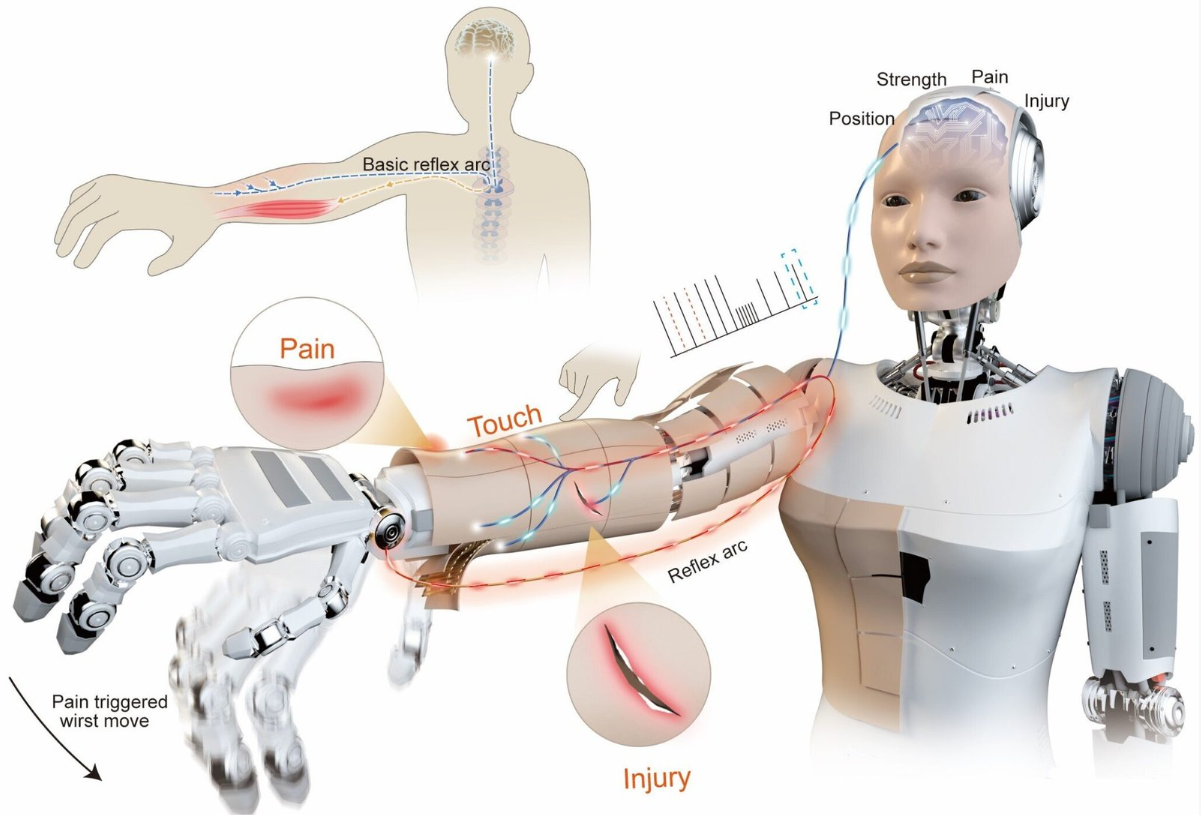
Most modern robotic skins are little more than sophisticated pressure pads. They can detect that they are being touched, but they lack the “intelligence” to interpret the meaning behind that contact. They cannot distinguish between a friendly pat and a damaging blow without a heavy lift from the central computer. The NRE-skin changes this dynamic by mimicking the hierarchical architecture of the human nervous system.
大多数现代机器人皮肤不过是复杂的压力垫。他们能感知到自己被触碰,但缺乏“智能”去解读这种接触背后的含义。他们无法区分友好的拍打和致命的一击。NRE-皮肤通过模仿人类神经系统的层级结构来改变这一动态。
This new electronic skin is composed of four distinct layers. The outermost layer serves as a protective epidermis, shielding the internal components from the environment. Beneath this surface lies a complex web of sensors and circuits designed to behave like biological nerves. This system doesn’t just wait for something to happen; it maintains a constant “heartbeat.” Every 75 to 150 seconds, the skin sends a small electrical pulse to the robot’s CPU, even when nothing is touching it. This serves as a continuous status report—a way for the skin to whisper, “Everything is fine.”
这款新的电子皮肤由四层不同的结构组成。最外层作为保护表皮,保护内部成分免受环境影响。在这表面之下,隐藏着一张复杂的传感器和电路网络,设计成像生物神经一样运作。这个系统不会只是等待事情发生;它保持着恒定的“心跳”。每隔75到150秒,皮肤会向机器人CPU发送一个微弱的电脉冲,即使没有任何接触。这作为持续的状态报告——让皮肤低语“一切正常”。
If the skin is ever cut or significantly damaged, this steady pulse stops immediately. This silence acts as an alarm, informing the robot exactly where the injury has occurred so it can alert its owner. This internal monitoring system ensures that a robot isn’t walking around with a “numb” or broken limb without the system realizing it.
如果皮肤被割伤或严重受损,这种稳定的脉冲会立即停止。这种“信号静默”如警报,准确告知机器人受伤位置,以便及时通知主人。该内部监控系统确保机器人不会在系统未察觉的情况下带着“麻木”或骨折的肢体行走。
When Touch Becomes a Warning当触碰成为警告时
The true breakthrough of the NRE-skin lies in how it categorizes physical interaction. When the skin is touched normally, it generates a signal known as a spike. These spikes carry precise data about the amount of pressure being applied, which is then sent to the CPU for standard processing. This allows the robot to understand the nuance of a gentle grip or a steady hand.
NRE皮肤的真正突破在于它如何分类物理互动。当皮肤被正常触摸时,会产生一种称为“尖峰”的信号。这些尖峰携带关于施加压力的精确数据,随后发送给CPU进行标准处理。这使机器人能够理解温柔握持或稳健手感的细微差别。
However, the system is programmed with a preset threshold for force. When a touch crosses the line from “pressure” to “extreme,” the skin recognizes it as pain. At this critical moment, the architecture shifts. Instead of waiting for the CPU to decide what to do, the skin sends a high-voltage spike directly to the motors.
然而,系统被编程为预设的力阈值。当触摸从“压力”到“极端”时,皮肤会识别为疼痛。在这个关键时刻,架构发生了转变。皮肤不再等待CPU决定,而是直接向电机发送高压尖峰信号指令。
By bypassing the central processor, the robot executes a local reflex. The arm pulls away instantly, mimicking the human withdrawal reflex. This decentralized approach ensures that the robot protects itself from harm at the speed of electricity, rather than the slower speed of computer logic.
通过绕过中央处理器,机器人执行本地反射。手臂立刻收回,模仿人类的非条件反射。这种去中心化的方法确保机器人以电的速度保护自己免受伤害,而规避了计算机逻辑慢速计算延迟造成的不良后果。
A Modular Solution for a Fragile World脆弱世界的模块化解决方案
Even with lightning-fast reflexes, accidents are inevitable in the unpredictable environments of homes and hospitals. Recognizing that robots will eventually need “surgery,” the researchers designed the NRE-skin with a clever, Lego-like modularity. The skin is not one continuous, irreplaceable sheet; instead, it is made of magnetic patches.
即使反应极快,在家庭和医院这些不可预测的环境中,事故依然不可避免。研究人员意识到机器人最终需要“手术”,因此设计了NRE-skin,采用了巧妙的乐高模块化设计。皮肤不是一块连续、不可替代的薄膜;而是由磁性贴片组成。
If a section of the skin is compromised, there is no need for a complex, hours-long repair process. Because of the magnetic design, an owner can simply snap off the damaged section and click a new, functional patch into place in a matter of seconds. This quick-release repair system ensures that maintenance is as intuitive as the skin’s reflexes, allowing the robot to return to its duties with minimal downtime.
如果皮肤某一部分受损,就不需要复杂且耗时数小时的修复过程。由于磁性设计,车主只需断开皮肤受损部分,即可在几秒钟内安装一个全新皮肤。这种快速维护使机器人能够以最小的停机时间恢复工作。
Why Feeling Pain Makes Robots Safer为什么感受疼痛让机器人更安全
As these machines move out of the controlled environments of factories and into our daily lives as empathetic service robots, the ability to feel becomes a safety requirement rather than a luxury. The development of the NRE-skin represents a shift toward more intuitive human-robot interaction.
随着这些机器从工厂的受控环境进入我们的日常生活,成为富有同理心的服务机器人,感受能力成为一种安全需求,而非奢侈品。NRE-皮肤的发展代表着人机交互更直观的转变。
This research matters because it changes the fundamental relationship between a machine and its surroundings. By giving a robot the ability to detect active pain and injury, we are creating machines that are more aware of their own physical limits. A robot that can “feel” is a robot that can avoid breaking itself—and more importantly, avoid causing accidents in a crowded home or a busy hospital ward.
这项研究之所以重要,是因为它改变了机器与其周围环境之间的根本关系。通过赋予机器人检测当前疼痛和伤害的能力,我们正在创造更能意识到自身物理极限的机器。能够“感知”的机器人,是指能够避免自我损坏的机器人——更重要的是,避免在拥挤的家庭或繁忙的医院病房中引发事故。
The team is already looking toward the future, working to refine the skin’s sensitivity. The next goal is to ensure the system can process multiple touches simultaneously without becoming confused, further closing the gap between the mechanical and the biological. By teaching robots to feel the sting of the world, we are ironically making them much more capable of navigating it safely.
团队已经开始展望未来,致力于优化皮肤的敏感度。下一个目标是确保系统能够同时处理多次触碰而不产生混淆,进一步缩小机械与生物之间的差距。通过教机器人感受世界的刺痛,反而让它们更能安全地在世界中生存。
资料来源:
This New Robotic Skin Can Feel Pain and React Faster Than a Computer Brain