

| 石英晶体:介绍与指南 QUARTZ CRYSTALS: INTRODUCTION AND GUIDANCE |
|||||||||||
|---|---|---|---|---|---|---|---|---|---|---|---|
| 1. 石英晶体 (QUARTZ CRYSTALS)
【中文】人造石英由硅和氧(二氧化硅)组成,并在高压和高温下的高压釜中培育而成。石英具有压电特性。当在晶体表面施加压力时,该器件会产生电势。相反,当在晶体表面施加电势时,会产生机械变形或振动。这些振动发生的频率由晶体设计和振荡电路决定。 【English】Synthetic quartz is composed of silicon and Oxygen (Silicon Dioxide) and is cultured in autoclaves under high pressure and temperature. Quartz exhibits piezoelectric properties. This device generates an electrical potential when pressure is applied on the surfaces of the crystal. Conversely, when an electrical potential is applied to the surface of a crystal, mechanical deformation or vibrations are generated. These vibrations occur at a frequency determined by the crystal design and oscillator circuit. |
|||||||||||
| 2. 石英切型/角度 (TYPE/ANGLE OF QUARTZ CUT)
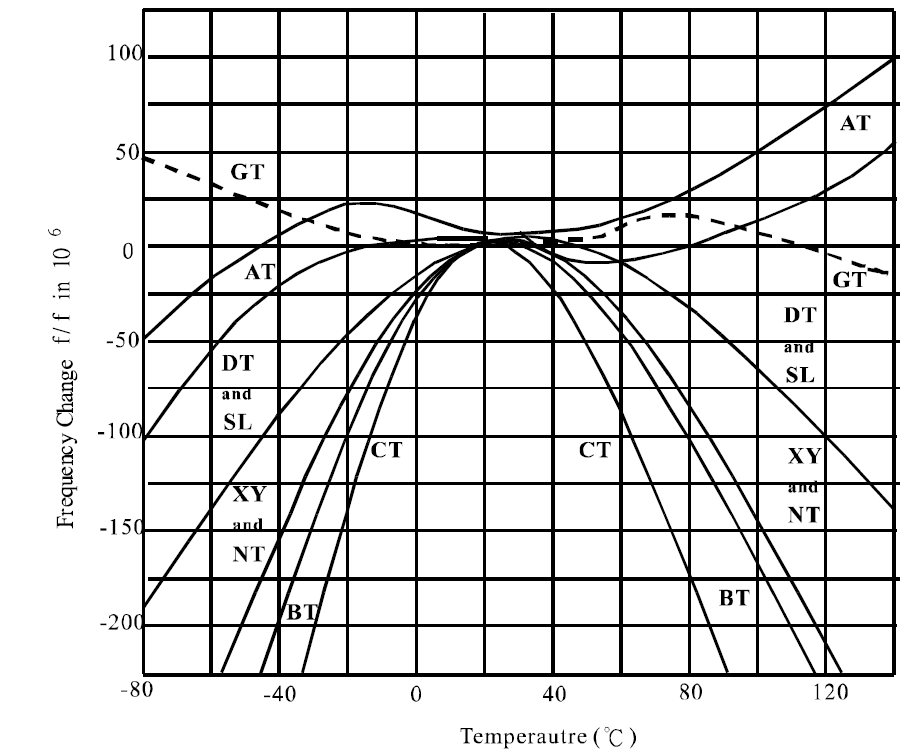
【中文】石英切型的类型和角度会影响晶体器件的运行参数,其中最重要的是频率稳定性。频率稳定性取决于晶体的平面或角度。该平面或角度被称为晶体的“切型”(cut)。如图1所示,由Y棒石英制成的常见厚度剪切晶体是“AT”切。在图2中,频率稳定性与工作温度范围的关系被绘制为“AT”切角的函数。请注意在约25°C处的拐点以及每个切角相邻上下转折点的位置。客户要求的频率稳定性和工作温度范围决定了所使用的切割角度。 【English】The type and angle of a quartz cut effects the crystal device operating parameters, the most significant being frequency stability. The frequency stability is dependant upon the plane or the angle of the crystal. The plane or angle is refereed to as the crystal “cut”. As shown in Figure 1, a common type of thickness shear crystal fabricated from Y bar quartz is the “AT” cut. In Figure 2, the frequency stability versus operating temperature range is plotted as a function of “AT” cut angle. Note the inflection point at approximately 25°C and the location of the adjacent upper and lower turning points for each cut angle. The frequency stability and operating temperature range required by the customer determine the angle of cut utilized. |
|||||||||||
| 2.1 振动模式与定向角 (Mode of vibration and orientation angle)
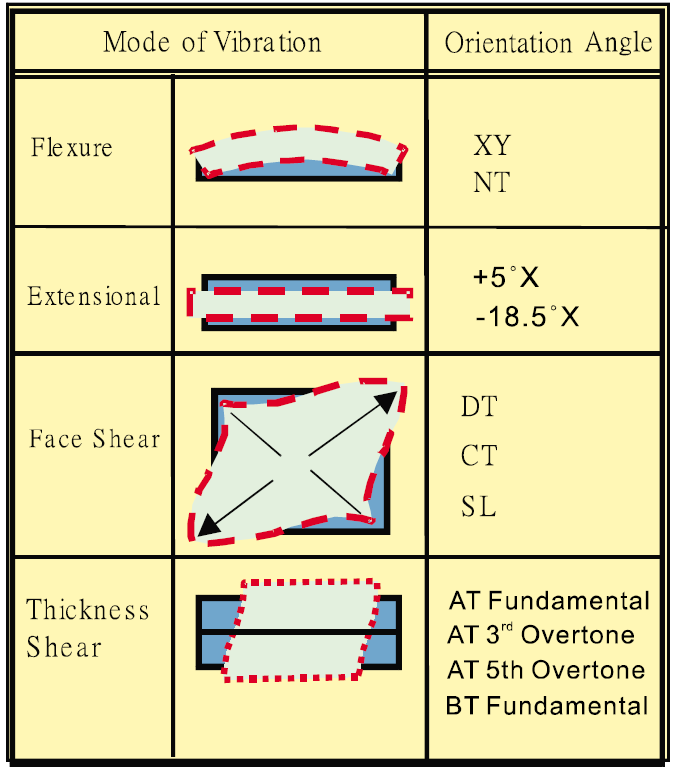
【中文】晶体单元的振动模式分为弯曲振动、伸缩振动、面剪切振动和厚度剪切振动。(见表1) |
|||||||||||
表1:振动模式、定向角 (Table 1: Mode of vibration, orientation angle)
表1显示了振动模式、定向角与长度或厚度尺寸之间的关系。 |
|||||||||||
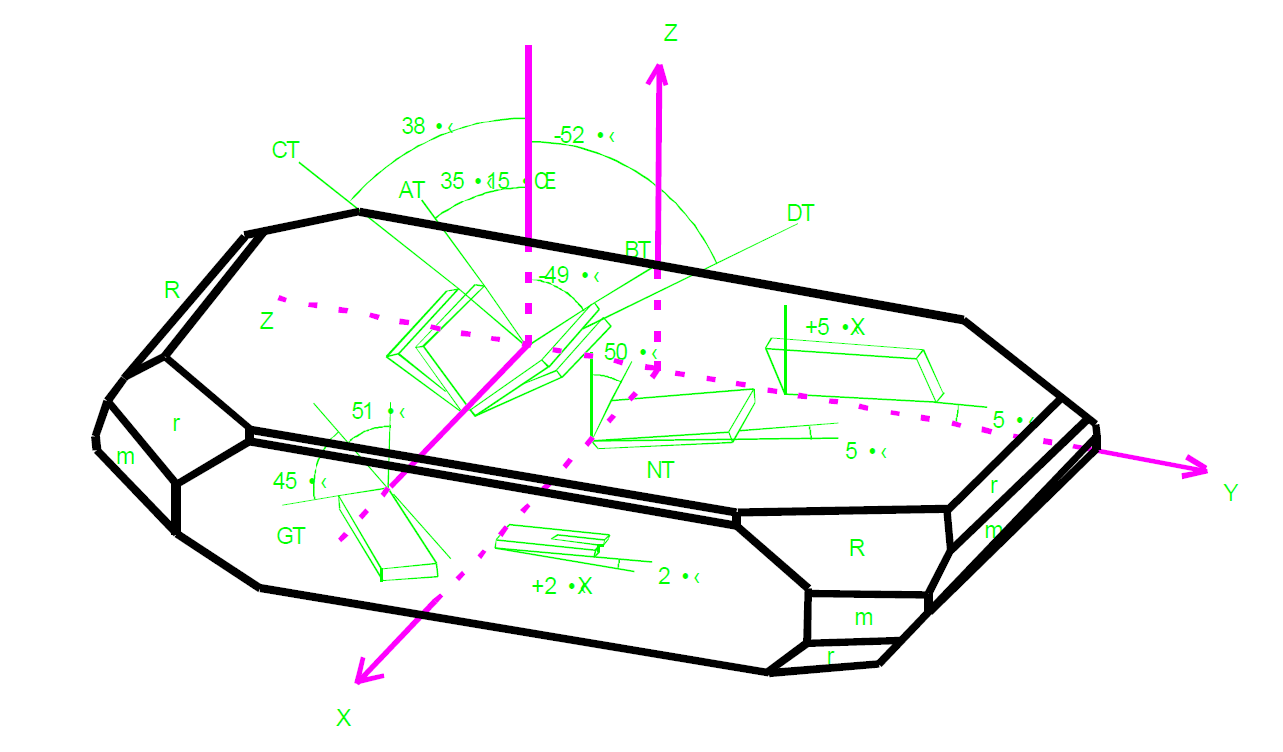
【图片说明:Fig.1 Orientation angle of Z-plate quartz crystal. / 图1:Z板石英晶体的定向角】
【中文】图1和图2显示了Z板石英晶体的定向角,在该角度下,对于最常用的振动模式,晶体单元的第一频率温度系数在正常室温附近变为零。 【English】Fig.1 and Fig.2 show the orientation angle of a z-plate quartz crystal at which the first frequency-temperature coefficient of crystal unit becomes zero near normal room temperature for the modes of vibration most often used. |
|||||||||||
| 2.2 频率-温度特性 (Frequency-temperature characteristics)
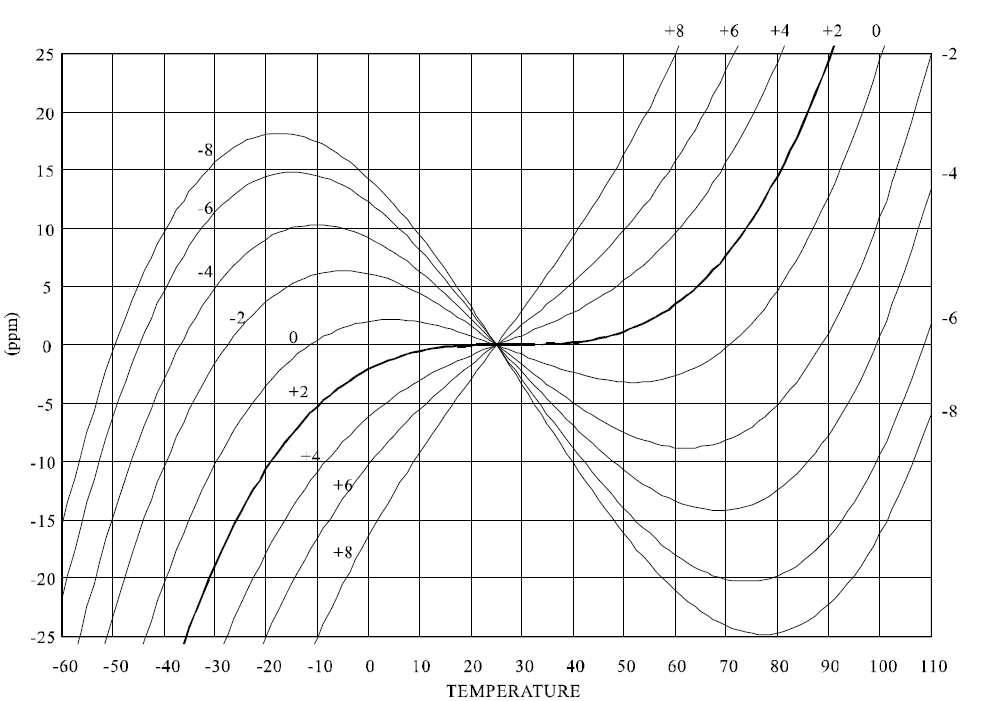
【中文】图3展示了以切角为参数的厚度剪切模式AT切晶体的频率-温度特性。AT切频率-温度特性等效于一个三阶方程,它在很宽的温度范围内也表现出优异的频率稳定性。 【English】Fig.3 illustrates the frequency-temperature characteristics for a thickness-shear mode AT-cut crystal with the angle of cut as a parameter. The AT-cut frequency-temperature characteristic is equivalent to an equation of the third order, it also displays excellent frequency stability over a wide temperature range.
【图片说明:Fig.3 AT-cut frequency-temperature characteristics / 图3:AT切频率-温度特性】 |
|||||||||||
| 3. 等效电路参数 (EQUIVALENT CIRCUIT PARAMETER)
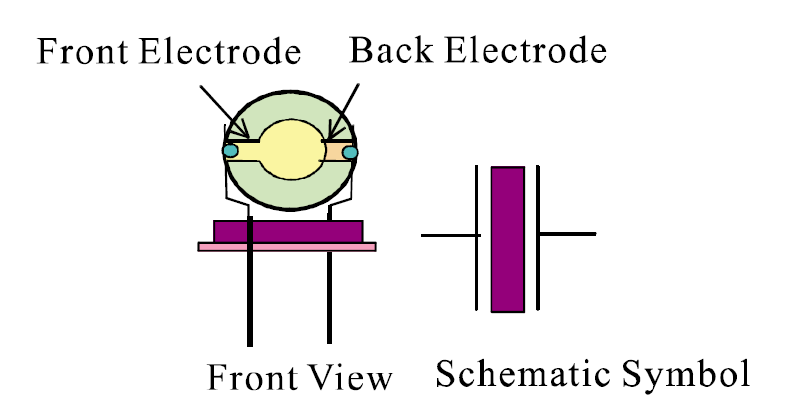
【中文】晶体器件由带有金属镀层的石英谐振器组成。图4显示了金属镀层位于晶体的两侧,并连接到晶体封装上的绝缘引线。该器件在两个晶体电极之间表现出压电响应,如图5所示的等效电路。 【English】A crystal device consists of a quartz resonator with metal plating. Figure 4 shows the metal plating is located on both sides of the crystal and is connected to insulated leads on the crystal package. The device exhibits a piezoelectric response between the two crystal electrodes as expressed in the equivalent circuit shown in figure 5 below.
【图片说明:Figure 4 / 图4:晶体结构正视图与原理符号】
【图片说明:Figure 5 / 图5:等效电路】 |
|||||||||||
| 3.1 动态电容 (C1) 与动态电感 (L1)
【中文】在上述等效电路(图5)中,动态电容和动态电感分别由C1和L1表示。对于“串联”谐振晶体,C1的值在频率(fs)处与L1的值谐振,如公式5所示: 【English】The motional capacitance and inductance are designated by C1 and L1, respectively, in the above equivalent circuit (figure 5). For a “Series” resonant crystal, the value of C1 resonates with the value of L1 at a frequency (fs) As expressed in Equation 5: fs = 1 / (2π√(L1C1)) (公式 5 / Equation 5) L1 = 动态电感 (Motional Inductance) = 1 / (4π²fs²C1) C1 = 动态电容 (Motional Capacitance) = 2(C0 + CL)Δf / fs 【中文】通常,在使用大多数晶体时不会提及L1。由于这个绝对方程,只需指定一个动态元件即可。行业标准是仅指定C1的适当值。在石英晶体设计中实现C1的实际值时,C1受到物理限制。这些限制包括工作模式、石英切型、机械设计和晶体的标称频率。 【English】Typically, L1 is not mentioned when working with most crystals. Due to this absolute equation, it is only necessary to specify one motional component. The industry standard is to specify a proper value of C1 only. The actual value of C1 has physical limitations when it is realized in a quartz crystal design. These constraints include the mode of operation, the quartz cut, the mechanical design, and the nominal frequency of the crystal. |
|||||||||||
| 3.2 静态电容/并联电容 (C0)
【中文】晶体端子之间的静态电容。以皮法(pF)为单位测量,无论器件是否振荡(与石英的压电效应无关),都存在并联电容。并联电容来源于石英的介电质、晶体电极的面积以及晶体保持架呈现的电容。 【English】The static capacitance between the crystal terminals. Measured in picofarads (pF), Shunt Capacitance is present whether the device is oscillating or not (unrelated to the piezoelectric effect of the quartz). Shunt Capacitance is derived from the dielectric of the quartz, the area of the crystal electrodes, and the capacitance presented by the crystal holder. |
|||||||||||
| 3.3 串联谐振与并联谐振 (SERIES vs. PARALLEL RESONANCE)
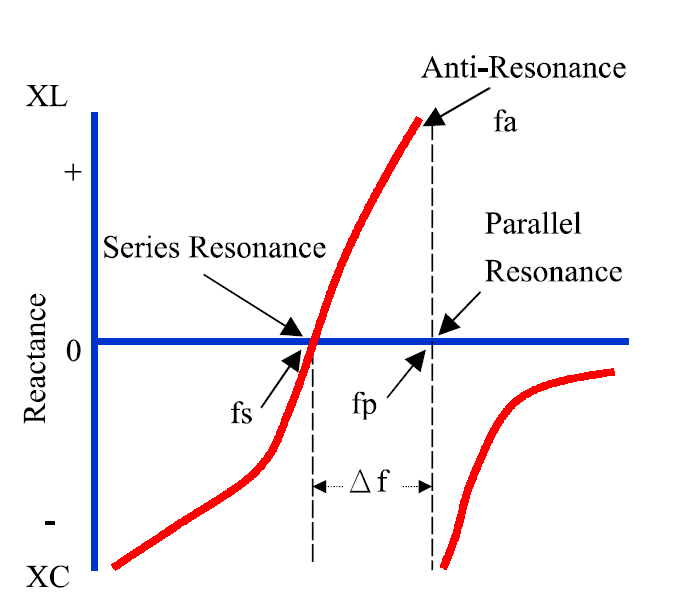
【中文】电气等效电路中有两种谐振频率。石英晶体同时表现出串联和并联谐振,如图6所示。 【English】There are two types of resonance frequency in electrical equivalent circuit. The quartz crystal exhibits both series and parallel resonance, as indicated in figure 6. 【中文】一种谐振发生在C1-R1-L1支路中,当 |XL| = |XC| 时;这被称为低阻抗串联谐振。另一种发生在C1-R1-L1支路中,当电抗等于C0时。在这种情况下,频率更高;这被称为高阻抗并联谐振。 【English】One type of resonance occurred in C1-R1-L1 branch when |XL| = |XC|; it is called the low-resistance series resonance. Another type occurred in C1-R1-L1 branch when reactance equaled to C0. Under this condition, the frequency is higher; and it is called high-resistance parallel resonance.
【图片说明:Fig.6 plot of reactance vs. frequency for a quartz crystal. / 图6:石英晶体的电抗与频率关系图】 |
|||||||||||
| 关键公式 (Key Equations):
fs = 动态(串联)谐振频率 (Motional (Series) Resonance Frequency) = 1 / (2π√(L1C1)) (公式 1 / Equation 1)
R1 = 串联谐振电阻 (Series Resonance) = 2πfsL1 / Q (公式 2 / Equation 2) fL = 并联负载谐振频率 (Parallel load Resonance Frequency) = fs { C1 / [2(C0 + CL)] + 1 } (公式 3 / Equation 3) RL = 负载“有效”电阻,也称为晶体阻抗(CI) (Load “EFFECTIVE” Resistance also name as Crystal Impedance (CI)) = R1 (1 + C0/CL) (公式 4 / Equation 4)其中:CL = 晶体负载电容 (pF) ; C0 = 晶体并联电容 (pF) |
|||||||||||
| 3.4 品质因数 (Quality Factor, Q)
【中文】晶体单元的“Q”是谐振时动态臂的品质因数。晶体所能达到的最大稳定性与Q直接相关,Q越高,带宽(Δf)越小,电抗斜率(fs-fa)越陡。与较低Q的器件相比,外部电路电抗值的变化对高Q晶体的影响较小(可牵引性较小)。 【English】The “Q” of a crystal unit is the Quality Factor of the motional arm at resonance. The maximum stability that can be attained by the crystal is directly related to Q, the higher the Q the smaller the bandwidth (Δf) and the steeper the reactance slope (fs-fa). External circuit reactance value changes have less effect on a high Q crystal (less pullability) than lower Q devices. Q = 品质因数 (Quality Factor) = 2πfsL1 / R1 = 1 / (2πfsC1R1)
|
|||||||||||
| 3.5 等效串联电阻 (EQUIVALENT SERIES RESISTANCE, ESR)
【中文】晶体器件的电阻元件,以欧姆为单位测量。在公式2中发现的频率处,动态电感(L1)和动态电容(C1)具有相等的欧姆值但相位完全相反。净结果是它们相互抵消,在串联谐振频率(fs)处仅留下电阻(R1),而不是在某个预定的并联谐振频率(fL)处。在串联谐振频率处测量的晶体阻抗(CI)通常被称为“有效”电阻(R1)。 【English】The resistive element, measured in ohms, of a crystal device. At the frequency found in Equation 2, the motional inductance (L1) and motional capacitance (C1) are of the equal ohmic value but are exactly opposite in phase. The net result is that they cancel out each other and only a resistance (R1) remains in the series resonance frequency (fs), not at some predetermined parallel resonant frequency (fL). Crystal impedance (CI) measured at series resonant frequency is often called the “effective” resistance. (R1). |
|||||||||||
| 4. 负载电容 (LOAD CAPACITANCE, CL)
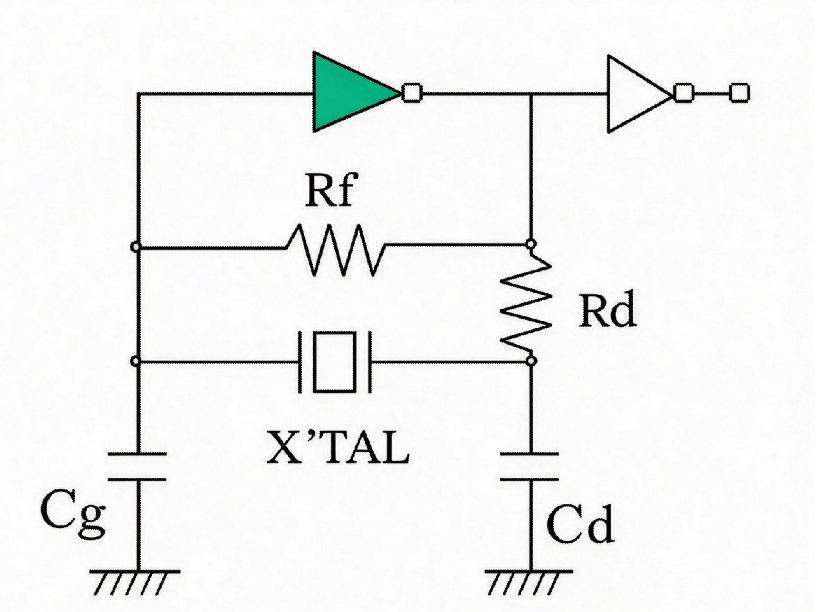
【中文】当振荡电路向晶体提供一定量的负载电容时,该晶体被称为“并联负载谐振”,并且必须指定负载电容的值。如果电路没有表现出任何电容性负载,则该晶体被称为“串联谐振”,并且不指定负载电容值。 【English】When an oscillator circuit presents some amount of load capacitance to a crystal, the crystal is termed “Parallel Load Resonant”, and a value of Load Capacitance must be specified. If the circuit does not exhibit any capacitive loading, the crystal is termed “Series Resonant”, and no value of load capacitance is specified. 【图片说明:Frequency and load capacitance characteristics AT-cut crystal unit (example) / AT切晶体单元的频率与负载电容特性(示例)】 【中文】振荡电路的负载电容差异可能导致振荡频率与所需频率或下图(图8)所示不同。电路负载电容的近似表达式如图9所示: 【English】Differences in the load capacitance of the oscillation circuit may result in a different oscillation frequency from the desired or shown in the figure 8. below. Approximate expression of the load capacitance of the circuit as Fig. 9 CL ≈ (Cg × Cd) / (Cg + Cd) + Cs
【图片说明:Oscillation circuit (example) / 振荡电路(示例)】 |
|||||||||||
| 晶体术语表 (CRYSTALS: GLOSSARY OF TERMS) | |||||||||||
| 1 激励功率/驱动电平 (DRIVE LEVEL, DL)
【中文】流经晶体的驱动或激励电流的函数。驱动电平是晶体中的功率耗散量,以纳瓦、微瓦或毫瓦表示。最大功率是器件在保证所有电气参数正常运行的同时仍能耗散的最大功率。驱动电平应保持在确保正确启动和稳态振荡所需的最低水平,从而避免老化特性变差和晶体损坏。 【English】A function of the driving or excitation current is flowing through the crystal. The drive level is the amount of power dissipation in the crystal, expressed in nanowatts, microwatts or milliwatts. Maximum power is the most power the device can dissipate while still maintained operation with all electrical parameters guaranteed. Drive level should be maintained at the minimum levels necessary to assure porper start-up and steady state oscillation, thus avoiding poor aging characteristics and crystal damage. |
|||||||||||
| 2 老化 (AGING)
【中文】在指定时间段内工作频率的变化,通常表示为每年百万分之几(ppm/year)的最大值。频率随时间变化是由许多因素引起的;密封方法和完整性、制造工艺、材料类型、工作温度和操作频率。 【English】The change in operating frequency over a specified time period and is typically expressed as a maximum value in parts per million per year (ppm/year). Frequency changes as a function of time is due to many factors; seal method and integrity, manufacturing processes, material type, operating temperature, and frequency of operation. |
|||||||||||
| 3 存储温度范围 (STORAGE TEMPERATURE RANGE)
【中文】器件在非振荡状态下可以存储或暴露的最低和最高温度。在最低或最高温度下暴露或存储器件一段时间后,所有运行规格在指定的工作温度范围内得到保证。 【English】The minimum and maximum temperatures that the device can be stored or exposed to when in a non-oscillation state. After exposing or storing the device at the minimum or maximum temperatures for a length of time, all of the operating specifications are guaranteed over the specified Operating Temperature Range. |
|||||||||||
| 4 可牵引性 (PULLABILITY)
【中文】“并联负载谐振”晶体的频率变化(以ppm表示)作为负载电容变化(以pF表示)的函数的规格。在某些应用(如VCXO)中,必须改变晶体的并联谐振频率,因此指定了可牵引性。石英晶体的可牵引性由上面的公式1推导得出,其计算如公式6所示。 【English】A specification for the change in frequency (expressed in ppm) for a “Parallel Load Resonant” crystal as a function of change in Load Capacitance (expressed in pF). In certain applications (i.e. VCXO) where variations in the crystals parallel resonant frequency are mandatory, pullability is specified. The pullability of a quartz crystal is derived from Equation 1 above and is calculated as shown in Equation 6 below. (fCL1 – fCL2) / fCL1 = (C1 / 2) { [1 / (C0 + CL1)] – [1 / (C0 + CL2)] } (公式 6 / Equation 6)
【中文】如公式所示,所需的频率变化(fCL1和fCL2)是给定负载电容变化(CL1和CL2)的直接结果。 【English】As shown from the equation, a desired change in frequency (fCL1 and fCL2) is a direct result of a given change in Load Capacitance (CL1 and CL2). |
|||||||||||
| 5 中心频率 (CENTER FREQUENCY)
【中文】晶体的指定中心频率通常以兆赫兹(MHz)或千赫兹(KHz)指定。 【English】The specified center frequency of the crystal is typically specified in megahertz (MHz) or kilohertz (KHz). |
|||||||||||
| 6 频率容差或校准精度 (FREQUENCY TOLERANCE OR CALIBRATION ACCURACY)
【中文】在环境温度(参考25°C)下偏离指定中心频率的频率偏差量。该参数用最大和最小频率偏差指定,以百分比(%)或百万分之几(ppm)表示。该偏差与一组工作条件相关,包括:负载电容和驱动电平。 【English】The amount of frequency deviation from a specified center frequency at ambient temperature (referenced at 25°C). This parameter is specified with a maximum and minimum frequency deviation, expressed in percent (%) or parts per million (ppm). This deviation is associated with a set of operating condition including: Load capacitance and drive level. |
|||||||||||
| 7 频率稳定性 (FREQUENCY STABILITY)
【中文】频率稳定性是偏离环境温度频率的频率偏差量。该偏差与一组工作条件相关,包括:工作温度范围、负载电容和驱动电平。该参数用最大和最小频率偏差指定,以百分比(%)或百万分之几(ppm)表示。频率稳定性由以下因素决定:石英切型、石英切割角度、工作模式和石英晶片的机械设计。 【English】Frequency Stability is the amount of frequency deviation from the ambient temperature frequency. This deviation is associated with a set of operating conditions including: Operating Temperature Range, Load Capacitance, and Drive Level. This parameter is specified with a maximum and minimum frequency deviation, expressed in percent (%) or parts per million (ppm). The frequency stability is determined by the following factors: type of quartz cut, angle of the quartz cut, mode of operation, and mechanical design of the quartz blank. |
|||||||||||


-

电话咨询 -

在线咨询 -

微信咨询 - top

电话:0755-23068369

-
电话咨询 -
在线咨询 -

返回顶部